Researchers at the Institut national de la recherche scientifique (INRS) in Canada have developed a three-dimensional imaging system capable of recording ultrafast phenomena at up to 150,000 frames per second. The technology, called C-BLIP (chromatically band-limited illumination profilometry), sets a new world record in profilometry, according to INRS. The study was published in Nature Communications on November 12, 2026.
The 150,000 frames-per-second record applies to the intensity 3D imaging mode. In color mode, the system streams 3D images continuously at 25,000 frames per second — still above the ceiling of about 22,000 frames per second of earlier fringe-projection techniques.
What C-BLIP filmed in 3D
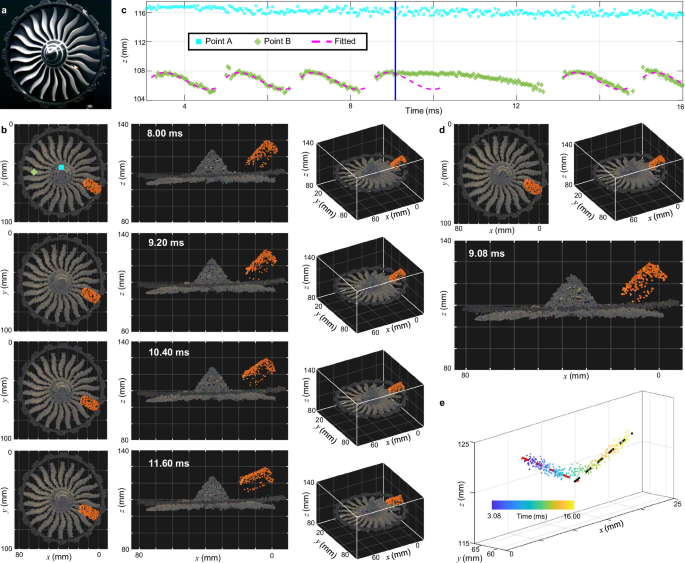
To demonstrate the system, the team recorded the collision of a projectile — an orange earplug — with a toy turbofan spinning at about 1,600 revolutions per minute, at 25,000 frames per second. The 3D reconstruction showed the exact moment of impact, the momentary compression of the projectile and the rebound, with its speed rising from 0.54 m/s before impact to 1.03 m/s afterwards.
The team also mapped the aerodynamics of falling Norway maple samaras (Acer platanoides) at 75,000 frames per second, resolved encrypted ultrasound signals at 150,000 frames per second and recovered a spoken message from ultrasonic vibrations captured on the surface of an object, as well as recording the vibrations of a loudspeaker membrane.
A more accessible system
Current ultrafast 3D imaging systems often rely on expensive cameras with limited internal memory, or on computationally heavy reconstruction. C-BLIP combines a cost-effective optical design, eye-safe LED illumination and a lightweight reconstruction method, making ultrafast imaging more practical and accessible for different laboratories. The team is now working on integrating GPU-accelerated processing, which could enable real-time visualization.
“With C-BLIP, we can continuously capture fast, non-repeatable three-dimensional phenomena that were previously difficult to observe and quantify. Beyond the speed record, this breakthrough opens new opportunities to better understand dynamic phenomena across a wide range of scientific and technological fields,” said Jinyang Liang, professor at INRS and Canada Research Chair in Ultrafast Computational Imaging, who led the work. The study's first author is Cheng Jiang, a postdoctoral researcher at INRS.
“What excites us most is the ability to observe phenomena that were previously invisible. C-BLIP even allowed us to visualize ultrasonic vibrations and recover a spoken message from them,” said Jiang.
Where the technology can be used
According to the researchers, C-BLIP can be applied in mechanics, aerodynamics, microfluidics, high-rate material testing and additive manufacturing, as well as biomedicine, autonomous driving and surface metrology.
Image: 3D reconstructions of a projectile colliding with a turbofan blade, captured by the C-BLIP system. Figure 3 from the study by Cheng Jiang and Jinyang Liang, published in Nature Communications (CC BY 4.0). Credit: Jiang and Liang / Nature Communications.
Sources
- INRS — Research Breakthrough in Ultrafast 3D Imaging
- Phys.org — Ultrafast 3D imaging captures fleeting motion at 150,000 frames per second
- Technology Networks — 3D Imaging Reveals Collisions and Ultrasonic Motion
- Jiang, C., Liang, J. — Ultrahigh-speed chromatically band-limited illumination profilometry, Nature Communications 17, 11567 (2026)
Transparency: this article was produced with the assistance of artificial intelligence, based on research and cross-checking of public sources on the internet, and reviewed before publication. See the original sources listed above for more details.
By Muse