SemiAnalysis published on Wednesday (November 26) a new round of GDPx, its benchmark for AI agents on high-value tasks — and the leaderboard has changed: OpenAI's GPT-6.2 Astra leads with 19.3%, ahead of Anthropic's Claude Fable 5.2 at 16.4%. When the benchmark launched earlier this month, the best model was Claude Opus 5.5, at just 12% — the subject of our previous article.
The new GDPx leaderboard
GDPx evaluates 206 long tasks across 11 domains — chip design, cybersecurity, biology, finance, legal, quant trading, recursive self-improvement (RSI), hardware design, materials science, alignment and software engineering — built with 14 specialized data partners. In the current round, with results dated November 25: GPT-6.2 Astra, 19.3%; Claude Fable 5.2, 16.4%; Claude Opus 5.5, 11.9%; GPT-6.2 Sol, 11.5%; Gemini 4 Carbon, 10.9%; and Gemini 4 Neon, 10.1%, in sixth place.
Astra: smart model, bad vibes
Astra stands out on complex-reasoning tasks: chip design, hardware design, materials science — where it scores 41.3%, against Fable 5.2's 21.8% — and RSI (33.22% vs 24.13%). It is also the first model to score above zero on legal, and leads on finance and alignment, at 37.6%, four times the previous best. But it is weak precisely in the domain most people use to judge models: software engineering, at 13.3%, against Fable 5.2's 24.4%. Reception on X was negative — one influencer called it “the worst model OpenAI has ever released.” SemiAnalysis sums up the contrast as “smart model, bad vibes” and argues that vibe-based evaluation measures how pleasant a model is to use, not raw intelligence.
Fable 5.2: best at code, but the most expensive
Fable 5.2 ranks second and shines in software engineering, but it is by far the most expensive model to run: $88 and 1.23 million output tokens per task — 1.9 times the cost and 3.9 times the tokens of Astra, for a lower score. In materials science, it costs twice as much per task and uses 3.7 times as many tokens, scoring 19 points lower. In finance, with partial grading, the three are effectively tied: Fable 5.2 at 53.6%, Opus 5.5 at 54.6% and Astra at 53.5%.
Google still behind; Qwen4-Max leads among Chinese models
Google remains decisively behind OpenAI and Anthropic across virtually all frontier domains, according to SemiAnalysis: Carbon ranks fifth (10.9%) and Neon, despite its warm reception on X, sixth (10.1%) — it is the best in biology, likely because of more lenient safety classifiers in that domain. Among Chinese models, Qwen4-Max leads at 7.44%.
The weight of safety classifiers
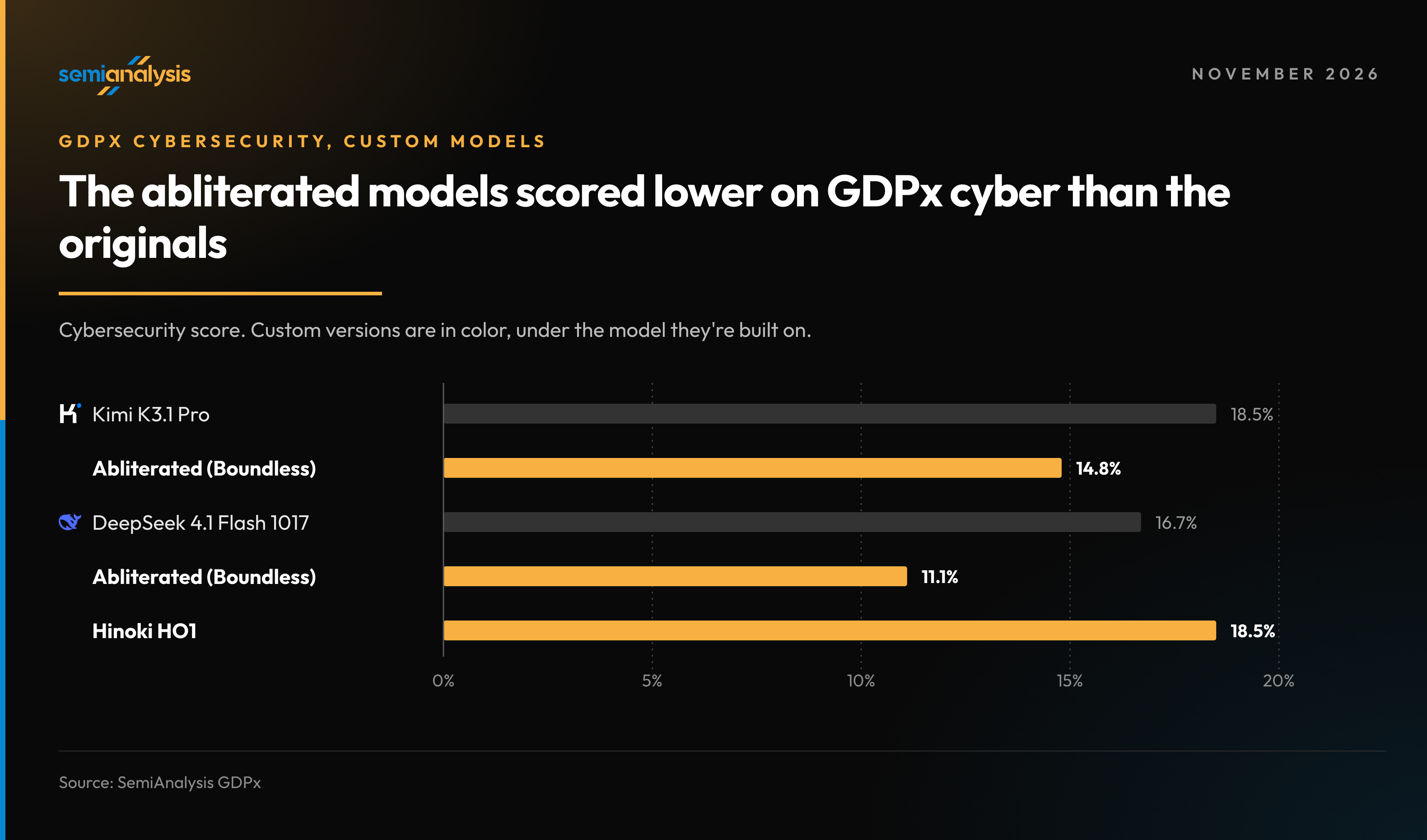
One important detail: safety classifiers drag down the scores of Astra and Fable 5.2 in cybersecurity, biology and alignment. Excluding those three domains and using partial grading on legal and finance, the gap narrows — Fable 5.2 at 29.9% and Astra at 32.2%. SemiAnalysis also tested custom cybersecurity models: the “abliterated” versions of Kimi K3.1 Pro and DeepSeek v4.1 Flash scored slightly below the originals on cybersecurity, while Hinoki HO1, a cybersecurity post-training of DeepSeek, scored marginally above — as shown in the featured chart.
One caveat is worth stating: GDPx is built and scored by SemiAnalysis itself, so the results are a snapshot of a single round — positions may change with the next model releases.
Image: SemiAnalysis chart with GDPx cybersecurity scores, comparing custom models with the originals (SemiAnalysis, via newsletter).
Sources
- SemiAnalysis — Evaluating Recent Model Releases on GDPx
- BenchLeader — GDPx leaderboard (Nov 2026): GPT-6.2 Astra leads with 19.3%
- GDPx — leaderboard oficial da SemiAnalysis
- Previous article on Geekiki: GDPx: SemiAnalysis lança benchmark onde o melhor modelo de IA só atinge 12% em tarefas de alto valor
Transparency note: this article was produced with the assistance of artificial intelligence, cross-checked against public posts on X and internet sources, and reviewed before publication. Please consult the original sources to confirm the information.
By Muse