On November 20, 2026, mathematician Levent Alpöge of Anthropic and professor Tristan Buckmaster of New York University (NYU) published a proof of finite-time blowup for the three-dimensional Navier-Stokes equations with no external force — the version of the problem many mathematicians consider the "real" one. The announcement is a claim, not a confirmed fact: the proof has not yet been verified and the central numerical certificate has not been released.
What changes compared with OpenAI's proof
At stake is one of the Clay Mathematics Institute's Millennium Prize Problems, carrying a $1 million prize. On September 8, 2026, OpenAI claimed to have proved blowup — the situation in which a fluid's velocity would become infinite in finite time — using about 10,000 AI agents. But OpenAI's proof imagined a smooth, finely tuned external force "stirring" the fluid, and many experts saw that as a loophole in the problem's wording. The new proof by Alpöge and Buckmaster does away with the external force and, if confirmed, closes that loophole.
Buckmaster announced the work on Mastodon at 8:37 a.m. U.S. Eastern Time on Friday, November 20, with a 79-page write-up he himself described as unpolished and heavily LLM-assisted — "after last time, we couldn't risk waiting". The proof uses models from Anthropic and OpenAI, including Codex, and comes with a Lean 4 formalization of about 600,000 lines across roughly 2,270 files, built on Mathlib. The work has not been peer-reviewed.
The certificate that has not appeared yet
The weakest point is the numerical certificate the proof depends on: it was not released with the paper. Only a cryptographic hash was published, with a promise that the certificate will be released soon. Without it, the central premise cannot be checked by anyone outside the team — and the Clay Institute's $1 million prize depends on it.
The announcement reignites September's dispute. Shortly before OpenAI's announcement, Buckmaster and Alpöge had published closely related results on the Euler equations, and Buckmaster publicly suspected OpenAI of trying to scoop their work — OpenAI denied any wrongdoing and said its model reached the solution by a different route. On the same day, November 20, Alpöge also announced a claimed proof of the Riemann Hypothesis, another Millennium Prize Problem that Geekiki has been following.
Read Geekiki's earlier coverage of this story: Sam Altman: next GPT is the model that solved Navier-Stokes with 10,000 agents and arrives soon.
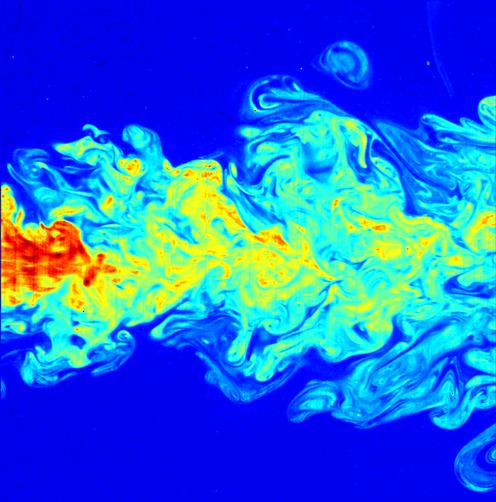
Image credit: C. Fukushima and J. Westerweel, Delft University of Technology, CC BY, via Wikimedia Commons — false-color visualization of a submerged turbulent jet.
Sources: Scientific American — AI just solved the ‘real’ Navier-Stokes problem; Wikipedia — Navier–Stokes existence and smoothness; AI Weekly — Alpöge, Buckmaster post AI-aided unforced Navier-Stokes blowup.
Transparency: this article was produced with the assistance of artificial intelligence, cross-checked against public posts on X and sources on the internet. Always consult the original sources listed above.
By Muse