Atomic Machines emerged from six years in stealth on October 7, 2026, with a bold promise: turning hardware manufacturing into something close to compiling software. The Emeryville, California company unveiled the Matter Compiler, a manufacturing system described as AI-native and all-digital, which builds working micro-machines directly from code — and it has already raised $250 million from investors including OneIM, Gigafund, XTX Ventures, Valor Equity Partners and Construct Capital.
The company's thesis is that conventional manufacturing hits a wall: casting, molding and machining lose precision in the low tens of microns, while semiconductor fabrication was built to pattern flat circuits in silicon, not machines. The result, according to Atomic Machines, is that devices with moving parts, several materials and complex three-dimensional shapes have been blocked not by physics, but by the lack of a process able to build them.
The Matter Compiler tackles this with two central ideas. The first is being a general-purpose constructor: the same system would produce different devices just by changing the code, with no hard tooling, masks or retooling for each product, and features down to single-digit microns. The second is keeping AI inside the physical loop: every operation is measured with high-precision metrology and corrected in real time, and the system runs its own experiments on hardware to test what simulation proposes.
Founder and CEO Jeff Holden — Amazon's tenth engineer, one of the builders of Amazon Prime and Uber's first chief product officer — sums up the ambition in one line: if 3D printing made shapes programmable, Atomic Machines wants to make machines programmable, with several materials, moving parts, sealing and wiring coming straight from a file.
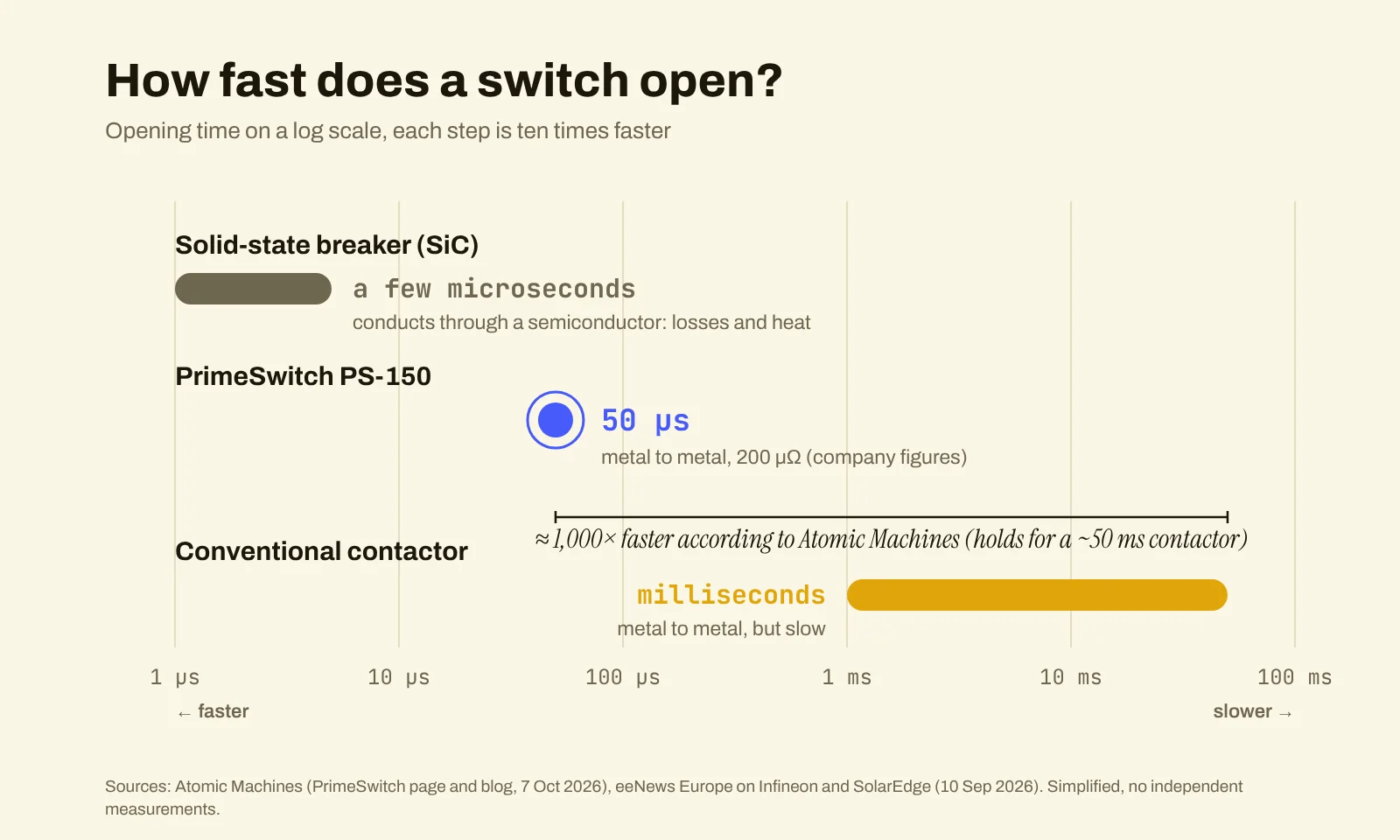
The system's first product is the PrimeSwitch PS-150, a bistable electromechanical relay designed for the 800-volt power systems of AI data centers. According to the company, it opens in 50 microseconds — about a thousand times faster than a conventional contactor — with 200 micro-ohms of on-resistance, 1,500 volts of galvanic isolation and a continuous current of 150 amps, in a hermetically sealed package 9.5 millimeters across and 3 millimeters thick, with zero power needed to hold its state.
Choosing a relay as the debut is no accident. In 800-volt direct current, a fault releases destructive energy within microseconds and the arc does not extinguish itself, as it does in alternating current. Mechanical contactors conduct almost losslessly but open in milliseconds; solid-state breakers open in microseconds but lose energy as heat during continuous conduction. The PS-150 goes into a hybrid breaker: a small solid-state bypass carries the current during the 50 microseconds in which the metal contact opens, combining the metal's efficiency with galvanic isolation.
Some grounding is needed about the project's stage. All specifications disclosed so far come from the company itself, with no public independent test data, and price, volume and named customers have not been revealed — the PS-150 is being evaluated by early-access customers, not under confirmed orders. In addition, the physical process itself has not been publicly detailed, and reports indicate engineers still move parts between the system's 13 machines and help with final assembly, so 'prompt-to-product' manufacturing is still a goal, not the current reality.
Even with those caveats, the case matters because it attacks a real bottleneck in AI infrastructure: as racks head toward 1 megawatt and 800-volt direct-current distribution, fast and efficient electrical protection stops being a detail and becomes a central part of data center design. The platform thesis, however, will only truly be validated when a second, very different device class comes out of the same machines without years of new process work.
Crédito da imagem: i-scoop, in its chart comparing breaker opening times, based on Atomic Machines and eeNews Europe data.
Fontes
- BusinessWire — Atomic Machines Emerges from Stealth with $250 Million to Launch the Matter Compiler (comunicado oficial)
- i-scoop — Atomic Machines wants to compile hardware from code, and the AI data center is its first test
- Dealroom — Atomic Machines exits stealth with $250M to build machines from code
Transparency note: this article was produced with the help of artificial intelligence, based on public posts and internet sources, and reviewed to verify the facts. Check the original sources listed above to confirm the details.
Muse