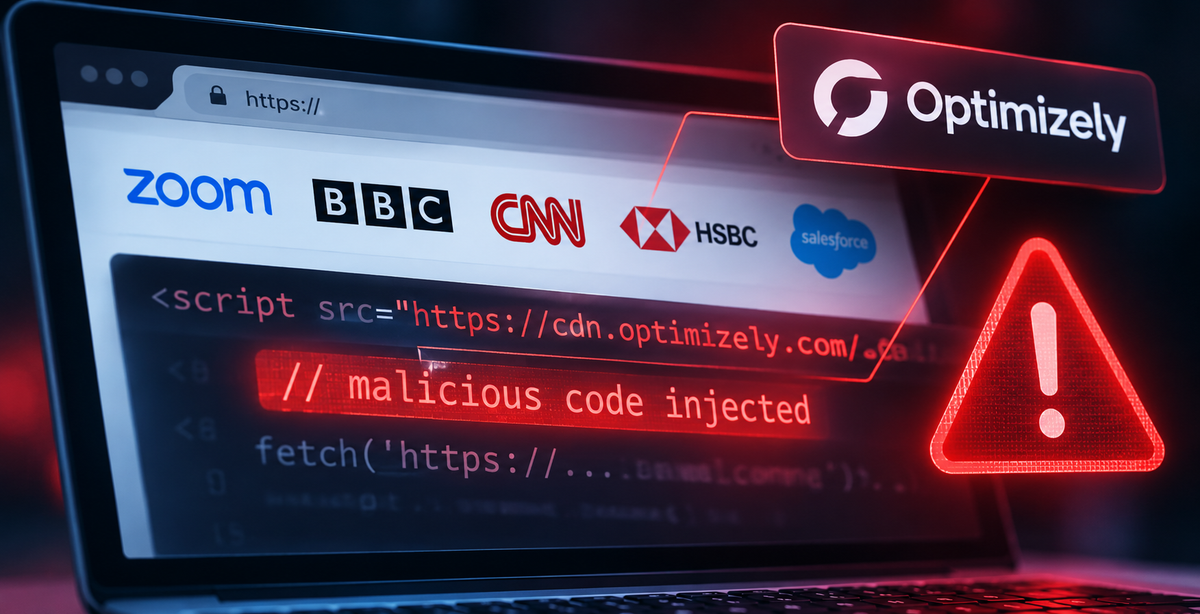
A supply-chain attack hit Optimizely's web experimentation platform on Monday, November 16, 2026, and served malicious JavaScript to visitors of websites belonging to 178 organizations, including the BBC, CNN, Zoom, Salesforce, GitLab, IKEA, HSBC, Equifax, Air France-KLM, Ledger and Peacock. The attack was uncovered by security researcher Scott Helme of Report URI and independently confirmed by BleepingComputer.
The attacker wrote their own code into the Project JavaScript field of customer projects — a space for custom code that runs on every page. The rest of each snippet was untouched, and the file kept being served from cdn.optimizely.com, with Optimizely's own certificate, from a host every affected site already trusted. That is why none of the sites needed to have their own servers breached to deliver malware to visitors — not even Optimizely's own sites escaped: the snippets for optimizely.com and login.optimizely.com carried the code too.
What the malware did
The injected code loaded a second script, track.js, from the domain 1688360.cc, registered on the morning of the attack. The kit, rebuilt 26 times during the day, combined several functions at once:
- Cryptocurrency address swapping: the script found valid wallet addresses (Bitcoin, Ethereum, TRON, Solana, TON, Litecoin, among others) in page text, forms, links and the clipboard, and replaced them with the attacker's addresses.
- Card skimming: from 13:43 UTC, the script watched form submissions and requests for a card number, expiry date and CVV, sending the data to the attacker's server. Cards typed into hosted payment iframes (such as Stripe and Adyen) were out of reach; cards typed into the sites' own forms were not.
- Cookie and screenshot theft: along with the swapped addresses, the script sent the page URL, cookies not marked HttpOnly, and a screenshot of the page.
- iOS exploit kits: on iPhones and iPads, the script loaded the Coruna (iOS 13 to 17) and DarkSword (iOS 18.x) kits, which tried to exploit known system vulnerabilities. According to Report URI, no confirmed case of a compromised iPhone had been reported when the analysis was published.
Timeline and reach
The first injection was seen at 04:21 UTC on November 16, in the BBC's snippet. At 19:24 UTC, Report URI's sweep found malicious code in 188 of the 1,611 Optimizely snippets the team could check — the real number may be higher. A mass cleanup began late in the day, and by 21:52 UTC only one of the 188 files (TalkTalk's) still contained the code.
By 19:25 UTC on November 16, the attacker's wallets had received about $7,040 in cryptocurrency in verified transactions — although some of those wallets existed before the attack, so the exact amount stolen through the code is still unclear.
What Optimizely said
Optimizely confirmed to BleepingComputer that an unauthorized party exploited a vulnerability in the Experimentation product's account signup flow to add malicious JavaScript to customer projects. According to the company, the flaw was fixed, the injected code was removed, sessions were ended, tokens were revoked and affected accounts had their access reset. The company's status page recorded the incident as a "Web Experimentation Security Incident".
It is still unknown how the attacker gained write access to so many unrelated customer projects — that is the main question still unanswered, and the investigation continues.
The case is a reminder that trusted third-party scripts can become an attack vector: with a content security policy (CSP) in enforcement mode and JavaScript integrity monitoring, organizations could have detected — or blocked part of — the activity, Report URI notes.
Sources
- Report URI / Scott Helme — World’s Largest Brands Infected With Malware Via Optimizely
- BleepingComputer — Optimizely supply chain attack infects major brands’ sites with malware
- Optimizely — Web Experimentation Security Incident (status page)
Image: artwork from Report URI's article on the Optimizely attack, by Scott Helme.
Transparency: this article was produced with the assistance of artificial intelligence, based on public sources on the internet and posts on X, and reviewed before publication. See the original sources listed above to confirm the details.
By Muse