Argonne National Laboratory in the United States has expanded its AI inference service with two new systems, Tara and Minerva. The announcement was made by the Argonne Leadership Computing Facility (ALCF) on November 4, 2026.
Tara and Minerva in numbers
Tara, developed with Hewlett Packard Enterprise on the HPE Cray Supercomputing EX4000 architecture, brings together 672 nodes with 2,688 NVIDIA GH200 Grace Hopper superchips and 258 TB of GPU memory in total — roughly 100 times the GPU memory previously available to the inference service.
Minerva, developed with World Wide Technology, is an eight-node cluster with 64 NVIDIA Blackwell B200 GPUs and 11.5 TB of high-bandwidth memory. ALCF also expanded Metis, its SambaNova-based platform, from two to six SambaRacks, for a total of 96 SN40L processors.
With the expansion, the inference service now hosts more than 50 models, including general-purpose LLMs, scientific foundation models and computer vision models — among them Google's Gemma series, Meta's LLaMA and OpenAI's GPT-OSS, as well as AuroraGPT, developed in-house at the laboratory.
Genesis Mission and the 100,000 agents
The expansion supports the Genesis Mission, the US Department of Energy (DOE) program to accelerate scientific discovery with AI agents. In a webinar on November 4, Rick Stevens, Argonne associate laboratory director and one of the mission's technical leads, stated that the goal is to have about 100,000 persistent agents running on DOE infrastructure by 2029. This is a goal stated by Stevens, not a plan published in an official DOE document.
Stevens also said a state-of-the-art agent consumes about 15 million tokens per day. The topic will be on the agenda at the SC26 conference, November 15–20 in Chicago.
The service is available to researchers at DOE laboratories, with authentication via Globus, and already supports agent tools such as Codex, Claude Code, OpenCode and Pi.
Read also: IBM, Oak Ridge and AMD create a platform for quantum error correction.
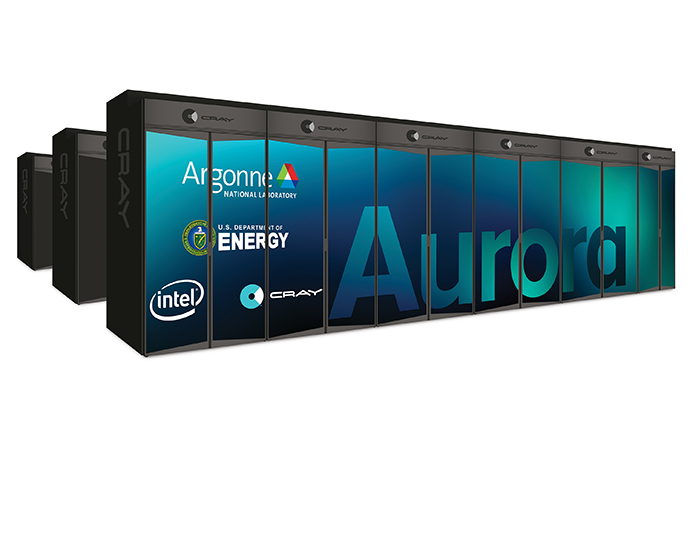
Image credit: the Aurora exascale supercomputer at Argonne National Laboratory (image: Intel, via R&D World). The photo illustrates the laboratory's supercomputing infrastructure; Tara and Minerva are separate systems.
Sources: Argonne Leadership Computing Facility — AI Inference; TechStrong — Argonne Scales AI Inference With New Systems; Supercomputing News — Stevens: Genesis Mission Targets 100,000 AI Agents by 2029.
Transparency: this article was produced with the assistance of artificial intelligence, based on public sources on the internet, and reviewed before publication. We recommend checking the original sources cited to confirm the details.
By Muse