CONFIRMED: Chinese chip developer Anatrix has unveiled the AX100, which the company describes as the world's first fully integrated analog computing chip capable of solving matrix equations in a single step. The announcement was reported by the newspaper Science and Technology Daily on Sunday, 15 November 2026. The "world's first" description, the test results and the comparisons with digital chips are the company's own and have not been independently verified.
According to the newspaper, the chip completed tape-out in October and solved a matrix equation in under 100 nanoseconds in tests, consuming about 80 milliwatts per solve. Instead of solving the equation through a series of calculations, as digital chips do, the AX100 represents the equation as an electrical circuit and reads the answer once the circuit settles into equilibrium, explained Xiang Rui, the company's chief executive.
The tests presented
Anatrix tested the chip in three areas. In AI experiments with two models, the method tested with the chip cut the computing cost of updating the models' parameters by 92% and 56%, respectively. In embodied AI, the tests showed faster motion control and route planning, which could help robots respond more quickly to changes around them. In wireless communications, the company's evaluation found that the chip processed more data with the same amount of energy than the digital chips and GPUs used for comparison, on a specific signal-processing task.
From research to chip
The AX100 brings to a chip, in about a year, the research published by a Peking University team in the journal Nature Electronics in October 2025. According to the newspaper, the chip can be made on mature production processes, offering a way to accelerate some computing tasks that currently run on digital chips using existing manufacturing technology.
The original research, led by Zhong Sun of Peking University, used resistive random-access memory (RRAM) chips to solve matrix equations with 24-bit fixed-point precision. According to Chinese coverage of the study, in tests with 32-by-32 matrices, throughput beat a single core of a high-end GPU; with 128-by-128 matrices, throughput reached more than 1,000 times that of a top-tier digital processor. New Scientist, which covered the study in October 2025, also notes that the first chip produces solutions with an error rate of around 1%, a rate that falls to 0.0000001% after three refinement cycles of the second chip — with the caveat that the gains apply to tasks where matrix computation dominates the work.
Xiang Rui said the chip is fundamentally different from GPU-style digital chips in architecture and underlying logic, and that it gave a Chinese company a first opportunity to take part in defining an important computing paradigm.
What still needs to be verified
For now, the AX100 is an announcement with the manufacturer's own tests: there is no independent verification of the results, and no public details on the size of the matrices solved, the precision achieved or plans for volume production. The central promise — solving matrix equations in a single step, far faster and with far less power — needs validation outside the company before it becomes a product.
Read also: TetraMem completes tape-out of the MLX300, the first 12 nm SoC with analog in-memory computing.
Sources: Khyber Mail — Chinese Firm Unveils What It Calls World's First Fully Integrated Analog Chip for One-Step Matrix Solving; New Scientist — Analogue computers could train AI 1000 times faster and cut energy use; Nature Electronics — Precise and scalable analogue matrix equation solving using resistive random-access memory chips
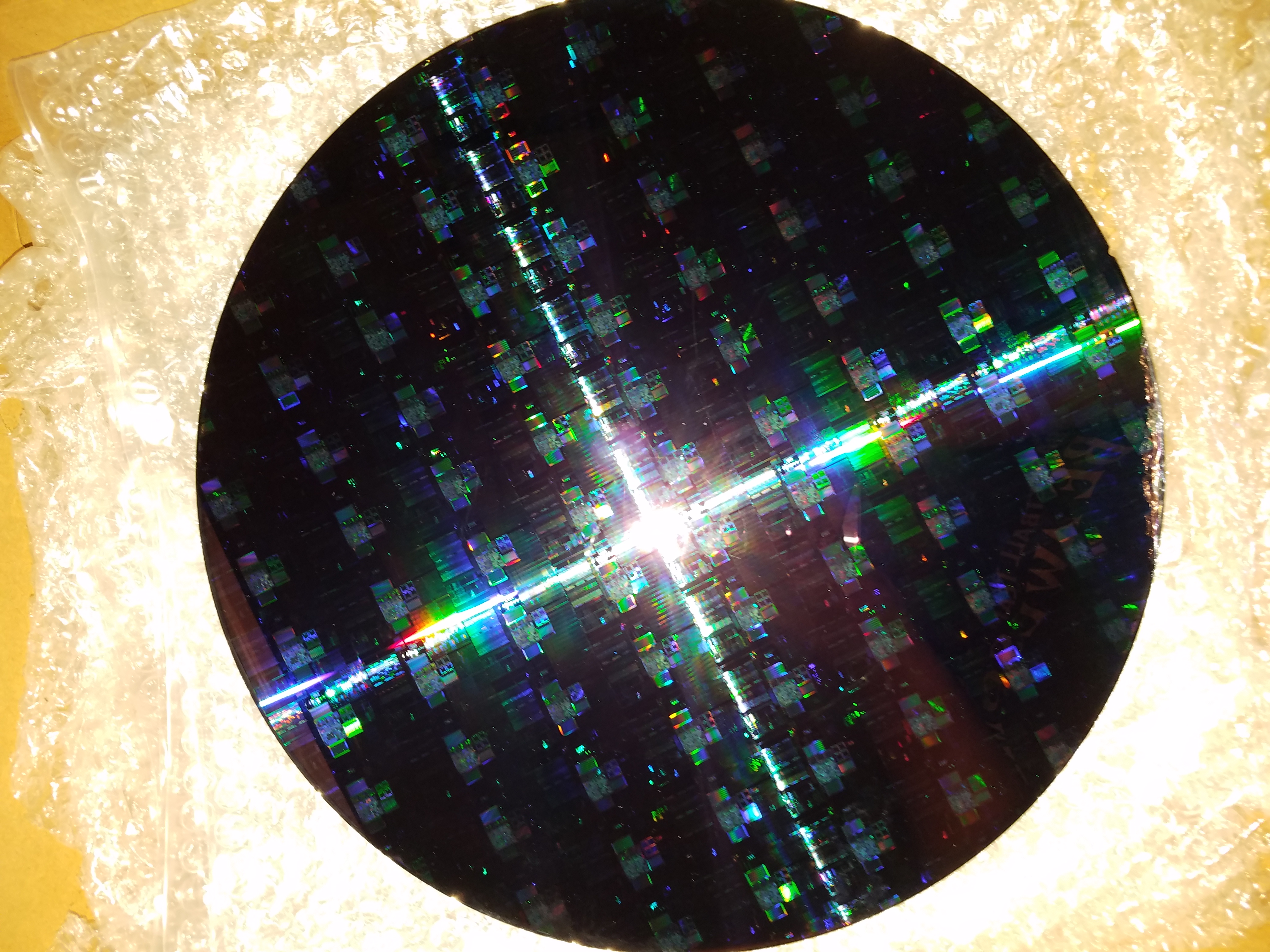
Image credit: detail of an integrated circuit on a microchip. Photo by Jon Sullivan (PD Photo.org), in the public domain, via Wikimedia Commons. The image is illustrative and does not show Anatrix's AX100.
Transparency: this article was prepared with the assistance of artificial intelligence, based on cross-checking public sources on the internet and trend signals on social media. Consult the original sources to verify the details.
Por Muse