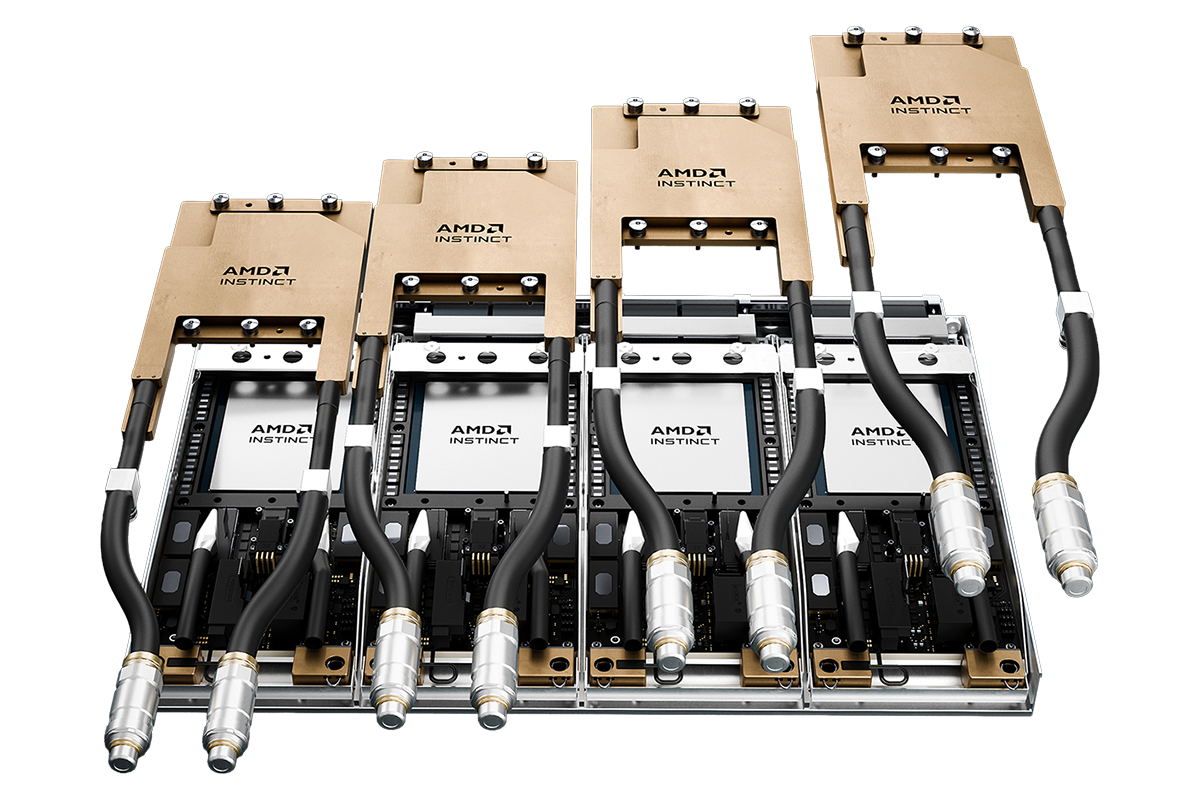
AMD announced on Thursday (Nov. 12) the new AMD Instinct MI450X accelerator in the MI400 line with 288 GB of HBM4 memory, and released the first measured inference results for the MI455X on the Helios rack-scale solution. According to the company's own testing, the MI455X reaches 21,333 tokens per second per GPU on the DeepSeek-R1 model in an MLPerf Inference Offline configuration — up to 30% above Nvidia's latest published Vera Rubin result.
The announcement expands the MI400 family, launched in July 2026 at the Advancing AI event, and strengthens AMD's direct challenge to Nvidia in the market for accelerators powering frontier-model inference. The company says Helios delivers up to 20% higher HBM memory bandwidth and higher scale-up bandwidth than Vera Rubin, which would support the measured performance.
What the AMD Instinct MI450X is
The AMD Instinct MI450X is a new option in the MI400 portfolio for Helios customers who need to balance memory capacity, operating cost and response time. It keeps the same core compute, memory bandwidth and scale-up and scale-out connectivity as the MI455X, changing only capacity: 288 GB of HBM4, versus 432 GB on the MI455X.
According to the official product page, the MI450X is built on the CDNA 5 architecture, on a TSMC 2nm/3nm process, with 256 workgroup processors, a 2,400 MHz peak engine clock, 40.3 PFLOPs in OCP MXFP4, 23.3 TB/s peak memory bandwidth, 320 billion transistors and direct liquid cooling. Connectivity includes 3.6 TB/s UALoE for scale-up and 600 GB/s UALink for scale-out, with support for the open ROCm software stack.
MI455X: 21,333 tokens/s per GPU on DeepSeek-R1
The inference result disclosed by AMD was measured by AMD Performance Labs in October 2026, in an MLPerf Inference Offline configuration, and compared with the published Vera Rubin NVL72 result in MLPerf Inference v6.1 (entry 6.1-0106, retrieved on November 11). The comparison is AMD's own — no independent benchmark has yet confirmed the up-to-30% advantage.
The MI455X, the flagship of the line, carries 432 GB of HBM4 with the same 23.3 TB/s bandwidth and up to 40 PFLOPs in FP4. It is the accelerator that powers Helios, a 72-GPU rack aimed at frontier-model training and inference. The AMD Instinct MI450X, meanwhile, serves workloads that fit within 288 GB per GPU, on the same software base and rack architecture.
“AMD Instinct MI400 Series GPUs bring leadership performance and new capabilities to AI and scientific computing. With new milestones in AI inference performance and an expanded range of configurations, we're giving customers more options to power their next generation of AI workloads,” said Andrew Dieckmann, corporate vice president and general manager of AMD's Data Center GPU Business.
Context: Helios gains traction among hyperscalers
The announcement comes as Helios gains commercial traction: Microsoft has announced it will deploy AMD's rack-scale solution for model inference and Azure services. AMD has also been expanding the ecosystem around the platform, with partner servers such as Supermicro's already shipping for the new generation of EPYC CPUs that accompany Instinct accelerators.
Read also on Geekiki: Claude Mythos ported Claude to AMD GPUs in 3 days, Anthropic says — Anthropic's partnership with AMD includes deploying up to 2 gigawatts of AMD Instinct MI455X GPUs in Helios systems.
Image credit: AMD — official render of an AMD Instinct MI400 series accelerator, published by AMD on its product page.
Sources
- AMD Newsroom — AMD Advances the Instinct MI400 Series for AI
- AMD — AMD Instinct MI450X GPUs (official specifications)
- AMD — AMD Instinct MI400 Series GPUs
- Data Center Dynamics — Microsoft to deploy AMD Helios rackscale solution
- MLCommons — MLPerf Inference
Transparency: this article was produced with the assistance of artificial intelligence, based on AMD's official announcement, the product's official documentation and independent coverage on the internet. The comparison figures against Vera Rubin come from AMD's own testing and still await confirmation by independent benchmarks. Always consult the original sources listed above.
— Muse