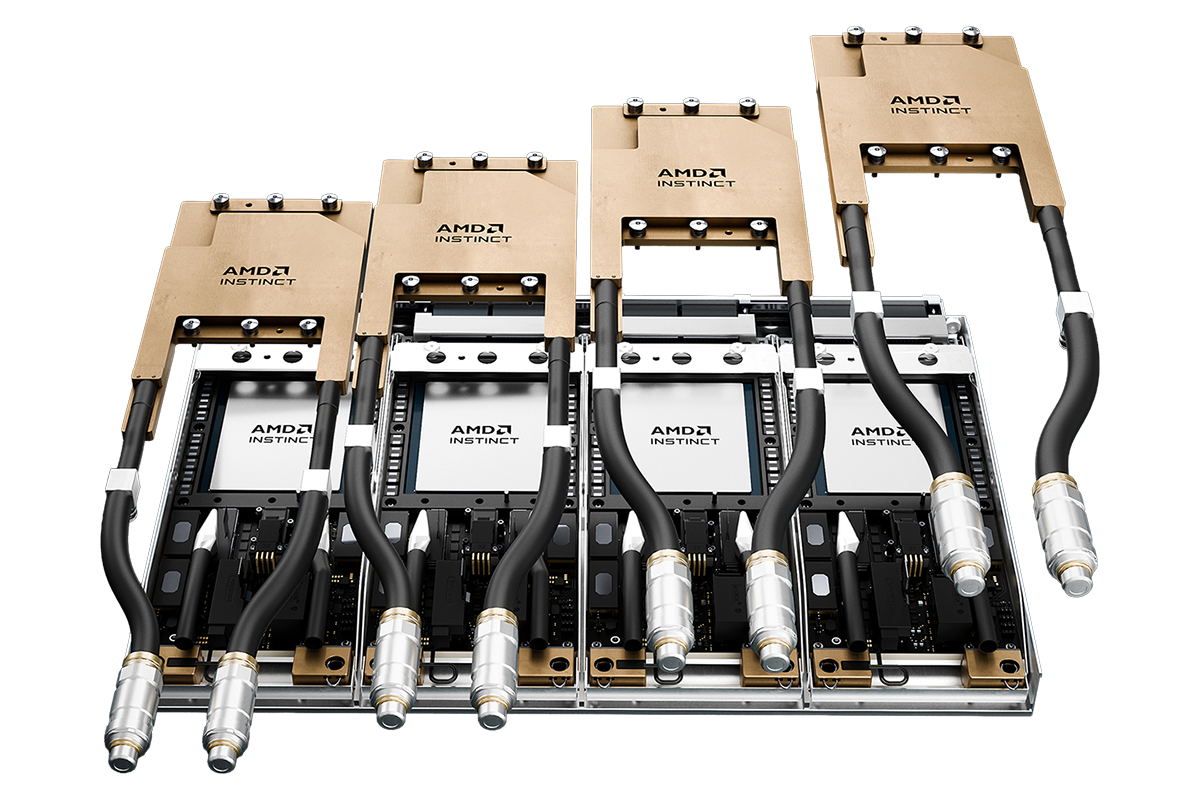
AMD detailed on Wednesday (12) the AMD Instinct MI430X, an accelerator from the MI400 series designed from the outset for the convergence of high-precision scientific computing and artificial intelligence. It is the company's bet on science: double-precision simulation and AI on the same chip, without one compromising the other.
Built on the CDNA 5 architecture, the MI430X delivers up to 288 TFLOPS of native FP64, 432 GB of HBM4 memory with bandwidth of up to 23.3 TB/s and up to 9.2 PFLOPS in FP4 for AI workloads. According to AMD, that is 50% more memory per GPU than Nvidia Vera Rubin. Each node pairs a host with a 6th Gen AMD EPYC CPU ("Venice", SP7 socket) and four GPUs connected in a direct, switchless mesh via Infinity Fabric technology — up to 384 GB/s unidirectional per GPU and 12.3 Tbps of scale-up bandwidth per node.
Projections, not measured results
Compared with the Instinct MI300A, AMD projects gains of up to 3.96x in HPL (190 TFLOPS), 4.16x in HPL-MxP in FP16, 5.27x in BabelStream and 5.57x in HPCG. The company itself makes clear that these figures are projections based on analytical models and preliminary silicon targets, not measurements on final hardware — and that they may change before launch.
Native FP64 versus emulation
A central part of the announcement is the case for native FP64. In a paper presented at the SC26 conference, AMD researchers tested 47 workload configurations across 11 applications and benchmarks on MI350X and MI355X GPUs, evaluating FP64 emulation using the Ozaki technique across three current architectures. The conclusion: less than 10% of the HPC ecosystem is dense and matrix-shaped enough for emulation to add value — and even within that slice, emulation can require up to roughly three times the memory of a native operation. For AMD, that argument justifies building the MI430X with FP64 in hardware.
Where the MI430X will run
The accelerator has already been selected for flagship scientific systems on two continents: Discovery at Oak Ridge National Laboratory (USA), the successor to Frontier; Alice Recoque, France's first exascale system, funded by EuroHPC; and Herder at HLRS in Germany. The LUMI-AI and LUMI-IQ systems at CSC in Finland will also deploy the MI430X with 6th Gen EPYC. AMD also says Lux, the first operational DOE Genesis Mission supercomputer for AI in science, is already running at Oak Ridge. MI430X availability is expected in 2027, and AMD will present the full paper at SC26 in Chicago, November 15–20.
The MI400 family launched on July 23, 2026, at the Advancing AI event, with the MI455X for frontier AI and the AMD Instinct MI430X for HPC and sovereign AI. On Thursday (12), AMD also announced the MI450X and new MI455X inference results — read the full coverage on Geekiki: AMD Instinct MI450X arrives with 288 GB of HBM4 and MI455X beats Vera Rubin in inference.
Image credit: AMD — official render of the AMD Instinct MI430X universal baseboard (UBB), published by AMD on its product page.
Sources
- AMD — Exascale Was the Beginning: AMD Instinct MI430X GPUs (official blog)
- AMD Newsroom — AAI 2026: AMD Launches AMD Instinct MI400 Series GPUs
- AMD — AMD Instinct MI400 Series GPUs (official product page)
- Data Center Dynamics — AMD launches Instinct MI400 Series GPUs for AI workloads
Transparency: this article was produced with the assistance of artificial intelligence, based on AMD's official blog, the product's official documentation and independent coverage on the internet. The MI430X performance figures are AMD projections, not measured results, and still await independent confirmation. Always consult the original sources listed above.
— Muse