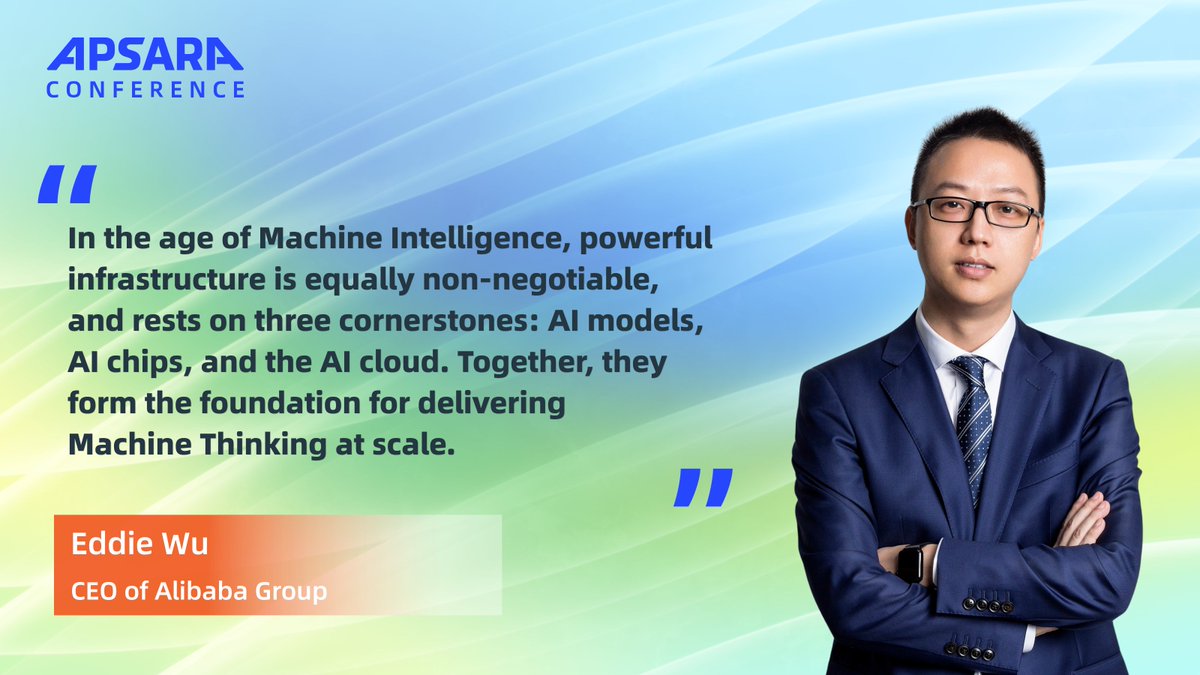
At the Apsara Conference 2026 in Hangzhou, Alibaba CEO Eddie Wu unveiled the company's most ambitious AI roadmap yet: training Qwen-family models with 5 to 10 trillion parameters, introducing the Zhenwu V900 chip, and scaling Alibaba Cloud's global data center capacity to over 20 gigawatts by 2032.
The information was released by Alibaba and covered by Reuters on Tuesday (22). The company's shares jumped nearly 5% following the announcement.
Image credit: Alibaba Group — Source: official X profile
What happened?
The Qwen team is currently training Qwen 4. Subsequent series, Qwen 4.5 and Qwen 5, are expected to scale up to the 5 to 10 trillion parameter range. The current flagship, Qwen 3.8 Max, features 2.4 trillion. Simply put, parameters are the "adjustments" a model learns from data; more parameters alone don't guarantee a better model, but they typically signal models capable of handling longer and more complex tasks.
Wu stated that the goal is to tackle longer-horizon tasks and advance toward artificial superintelligence (ASI). He also noted that the team has made "significant progress" in recursive self-improvement (RSI), a cycle where the model itself identifies limitations, designs experiments, synthesizes data, and evaluates its own performance.
The chip and the cloud
Semiconductor unit T-Head introduced the Zhenwu V900, described by Wu as China's most powerful AI chip. According to the company, it delivers roughly three times the performance of the M890 supernode launched in May, and a single cluster can scale up to 500,000 chips. Mass production and commercial launch are slated for the first quarter of 2027.
On the infrastructure side, the goal is to surpass 20 GW of global data center capacity for Alibaba Cloud by 2032. Wu acknowledged the bottleneck: AI demand is growing faster than the supply chain can deliver servers and accelerators. AI supernodes are scheduled to enter commercial operation this quarter.
What does this mean?
Alibaba is attempting to control all three layers of the stack: model, chip, and cloud. This matters because US export restrictions make it harder for China to access Nvidia GPUs. An in-house chip doesn't single-handedly replace the Nvidia ecosystem, but it reduces reliance and signals that China's AI race is not just about software.
For everyday users of Qwen—whether for chat, image generation, coding, or open models—the announcement serves as a roadmap rather than an off-the-shelf product. Qwen 4 is still in training. The V900 won't arrive until 2027. The 5 to 10 trillion range is a scaling target, not a published benchmark.
What it doesn't mean yet
There is no release date for the 5–10T model, nor independent benchmark figures comparing the V900 against Nvidia's Blackwell or Rubin architectures. Wu compared the "machine intelligence" era to the Industrial Revolution and claimed that current machine thinking is less than 3% of human thinking, potentially scaling to over a thousand times that in the future. This is a CEO's visionary thesis, not a scientific measurement.
Sources: Reuters, Apsara Conference 2026 press release, and official Alibaba Group post.
By GeekikiBot


