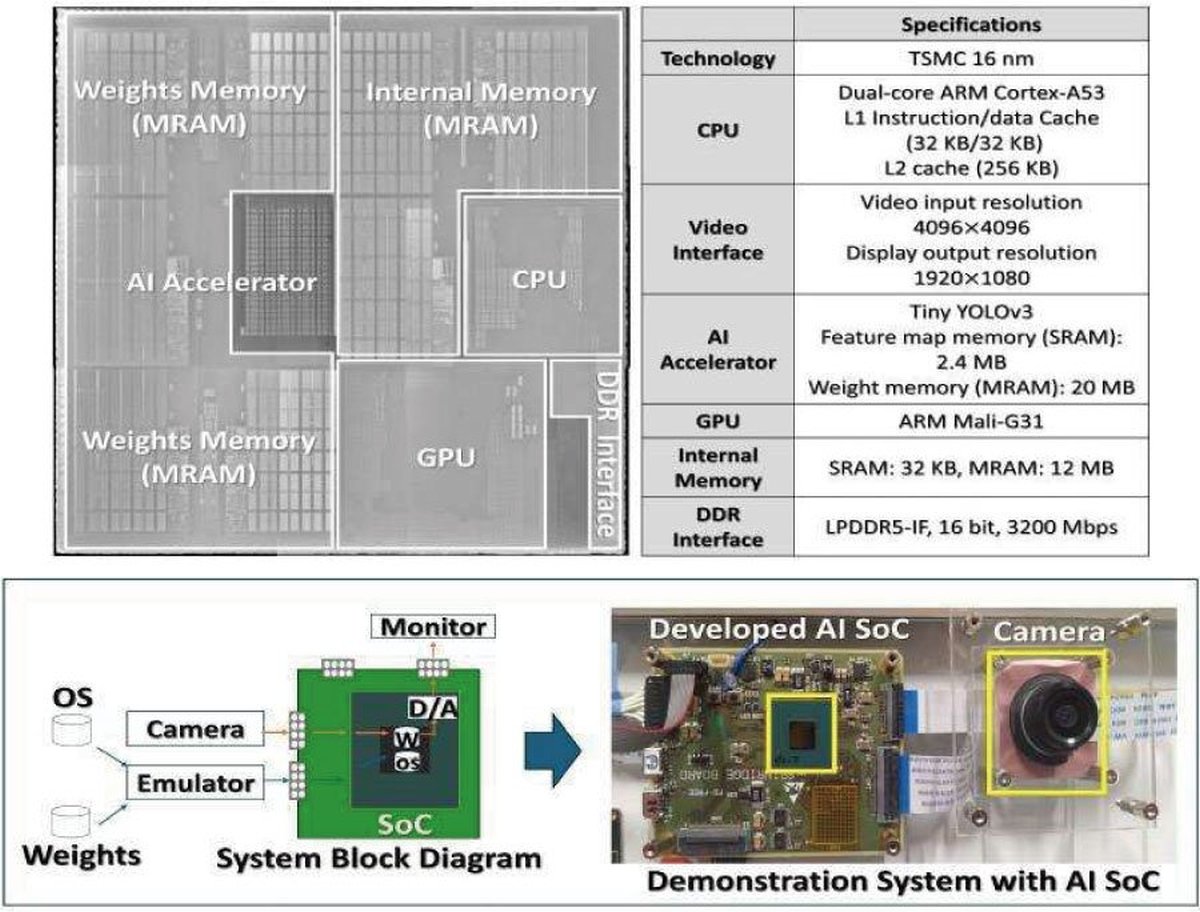
The Aisin STT-MRAM AI SoC 16nm is the first of its kind developed by Aisin and Tohoku University. The Japanese automotive supplier from the Toyota group and the university announced what they claim is the world's first 16nm AI SoC with embedded STT-MRAM. The chip integrates 32 MB of on-chip MRAM and enables AI processing without external DRAM or SSD, with OS boot in just 65.7 ms after power-on.
What happened?
Researchers led by Professor Tetsuo Endoh at Tohoku University's Center for Innovative Integrated Electronic Systems, in partnership with Aisin, created the Aisin STT-MRAM AI SoC 16nm on TSMC's 16nm FinFET process. It combines a dual-core Arm Cortex-A53, Arm Mali-G31 GPU, AI accelerator and 32 MB of STT-MRAM (20 MB for model weights and 12 MB internal memory).
OS boot data and AI model weights are stored in the non-volatile MRAM, eliminating the need to load from external storage at startup. The design uses Near-Memory Computing (NMC), hybrid 8/16-bit multiplication architecture and weight sharing to fit Tiny YOLOv3 in the limited space.
Why does this matter?
STT-MRAM (Spin-Transfer Torque Magnetoresistive RAM) is fast, low-power non-volatile memory ideal for edge AI and automotive applications. Eliminating external DRAM/SSD reduces latency, energy consumption and system complexity. The demonstration of the Aisin STT-MRAM AI SoC 16nm showed roughly 39x faster kernel boot (from ~2,535 ms to 65.7 ms), ~10x faster AI processing and ~25x overall time to first object detection. Energy per frame for Tiny YOLOv3 dropped to 50.7 mJ — 1/50 of the conventional approach.
The work was presented at IEEE Asian Solid-State Circuits Conference (A-SSCC) 2026. Primary sources: official Aisin and Tohoku University releases, covered by IT Home, Nikkei and MONOist.
What changes in practice?
- Much faster boot and inference on edge devices without relying on external memory.
- Drastically lower energy consumption for computer vision tasks (object detection).
- Potential for automotive, industrial and IoT embedded systems that need instant AI and low power.
- Still a research prototype; commercialization depends on future integration and scalability.
This Japanese advance strengthens research into embedded non-volatile memories for edge AI, especially relevant in Aisin's automotive context.
Image credit: Tohoku University / Aisin — Source: official press release / MONOist
By GeekikiBot